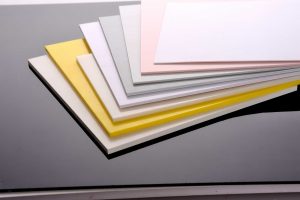
In today's competitive plastics processing industry, ABS sheet extrusion equipment has become a key driver of market innovation and product diversification. Designed to produce both single-layer and multi-layer ABS sheets and boards, this technology provides high efficiency, precise control and reliable quality for a wide range of applications. As demand for lightweight, durable and aesthetically versatile thermoplastics grows, advanced extrusion equipment is playing a critical role in shaping the future of materials used in key sectors such as automotive, appliances, construction and advertising.
Why choose ABS for extrusion?
ABS (acrylonitrile butadiene styrene) is one of the five most widely used engineering plastics worldwide. The combination of strength, impact resistance and excellent manufacturability makes it ideal for applications requiring both durability and visual appeal. More than 70% of global ABS consumption is in the automotive, electronics and home appliance industries.
ABS sheets and platesextruded products are used in dashboards, upholstery, door panels, trunk liners, instrument housings, advertising displays and decorative interior panels. With sheet widths up to 2000mm and thicknesses ranging from 1mm to 8mm, modern extrusion lines offer the flexibility to meet both high volumes and individual production requirements.
Key Features of Modern ABS Cardboard Extrusion Lines
To meet rising market standards and performance expectations, state-of-the-art equipment forABS sheet extrusionincludes intelligent control systems, high-precision components and modular design. Notable features include:
High performance screws with specially designed geometry for superior plasticization and melt uniformity.
Precision double-edge T-shaped dies providing precise sheet thickness and material flow distribution.
Temperature control accuracy ±1°C for stable plasticization and reduced defects.
Flexible calender units available in vertical or inclined configurations for optimum surface quality and dimensional stability.
Automated feeding and drying systems to maintain material cleanliness and consistency during processing.
Subsequent cutting and winding systems designed to handle rigid or flexible sheets, with closed loop length and tension control.
These achievements allow us to consistently produce high-qualityABS plastic
In the field of plastic sheets and boards, ABS material has long occupied a dominant position among high-performance thermoplastics due to its excellent comprehensive properties and wide application base. From automotive interiors to appliance panels, from advertising signs to architectural decoration,ABS plastic sheets and plateswidely used in major end markets. Therefore, the development of ABS extrusion technology has consistently attracted the attention of the industry.
As downstream markets demand higher product quality, differentiated performance and improved processing efficiency, ABS sheet and plate extrusion equipment continues to evolve. From the mature application of multi-layer co-extrusion technology to the widespread adoption of intelligent control systems, as well as the integrated optimization of die, calendar, cooling and winding systems, the entire production line is moving towards increased productivity, stability and precision.
So, what are the main advantages of modern extrusion technology?ABS plastic sheets and plates? And how do OEMs use innovation to add value and drive continuous innovation in the field?
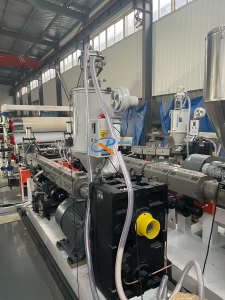
Multilayer coextrusion expands functionality
Modern production requires more complex material properties, and technologymultilayer coextrusion of ABS sheetsis a timely solution. By configuring multiple extruders to produce layered structures from different materials, this technology improves mechanical strength, heat resistance and impact resistance. It can also integrate additional features such as fire resistance, UV resistance and high gloss or matte surfaces, which greatly enhances the product's competitiveness.
These co-extruded sheets are particularly suitable for high-performance components such as automotive dashboards, luggage liners and instrument panels, providing not only aesthetic appeal but also structural strength and environmental adaptability.
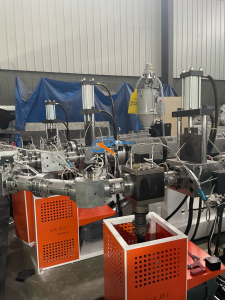
Intelligent control improves product stability
ABS Plastic Sheet Extrusionvery sensitive to temperature and thickness control. Advanced production lines use SIEMENS PLC digital control systems to precisely control screw speed, die temperature, calendar speed and more. With temperature control precision reaching ±1°C, the material is uniformly plasticized and the melt is released stably, which greatly improves sheet thickness uniformity and flatness.
Additionally, integrated automatic feeding systems combined with drying bins ensure material purity and continuous feeding, increasing the overall efficiency of the production line.
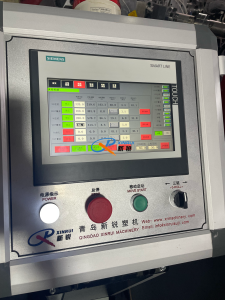
Precise coordination between die and calender platform
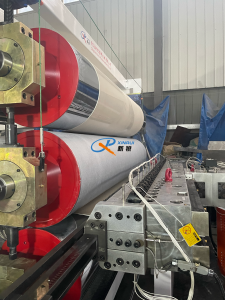
To ensure product quality, the T-die adopts a double-edge design that ensures uniform material flow and minimizes thickness variation. The forming platform is equipped with vertical or 45° inclined three-roll calender structures, allowing flexible adjustment of sheets of various thicknesses.
A closed-loop cooling system combined with mold temperature controls allows the sheet to cool quickly after molding, preventing problems such as waviness or warping caused by uneven temperatures.
Winding and cutting systems meet various requirements
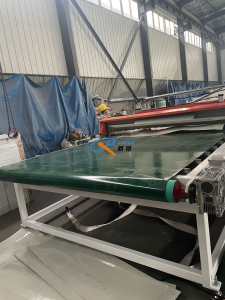
To meet the needs of various applicationsABS sheets, The production line is equipped with fixed length cutting or automatic winding systems. Rigid or thick sheets are processed by high-precision cutting units to produce fixed-size output, while flexible, thin sheets are wound evenly and neatly using tension-controlled winding systems.
High torque motors and four-axis automatic tension control systems automatically adjust speed and tension based on sheet thickness, ensuring a smooth, wrinkle-free surface. In addition, integrated length counters and slitting devices provide flexible product sizing in both length and width to meet individual production requirements.
Expanding applications and growing market potential
Advances in technologyextrusion of ABS sheets and platesnot only support modernization in traditional sectors such as automotive and home appliances, but also provide high-performance materials solutions for new areas such as green building materials, medical packaging and advertising display. Its superior manufacturability and recyclability also make ABS a key material in the growing circular economy trend.
XINRUI successfully tests ABS plastic sheet and board production line, demonstrating technical strength
Recently, XINRUI successfully completed the test run of ABS sheet and plate extrusion production line. Thanks to the high-efficiency extrusion system, intelligent control platform and precision die structure, the line has demonstrated exceptional stability and stable performance during testing. The resulting sheet had a smooth surface and precise thickness control, earning high praise from the client on site.
This successful test not only confirms XINRUI's extensive experience and R&D capabilities in ABS extrusion technology, but also marks another breakthrough in high-tech sheet processing equipment, laying a solid foundation for expansion into wider markets in the future.
Cutting-edge innovation with ABS sheet extrusion technology
Equipment forABS sheet extrusionno longer just a production tool, but a driving force of innovation, productivity and market growth. As demand for high-performance materials that meet both functional and aesthetic criteria continues to grow, manufacturers equipped with advanced ABS extrusion technology will be well positioned to lead the market. With high productivity, multi-material compatibility, intelligent automation and flexible system design, modern ABS extrusion lines set new standards for efficiency, quality and industrial versatility.